“My project is literary. But in a way, I wish to stay underneath literature.”
Annie Ernaux
<-- Home
“My project is literary. But in a way, I wish to stay underneath literature.”
Annie Ernaux
Our language is theater and we carry Annie Ernaux’s writing project with it. By picking Annie Ernaux’s book, we pay tribute to her work and we measure the legacy she leaves for our generation : the feeling of social shame can now be a form of knowledge and so, possibly, a creative strength. But we also measure that her work is not over and has to be continued. Some words, voices, bodies, faces are still absent in the public area. We have to find out how to change that within theater.
Charlotte Le Bras – May 2019
Theatrical variation with the book by Annie Ernaux
© Editions Gallimard (1987)
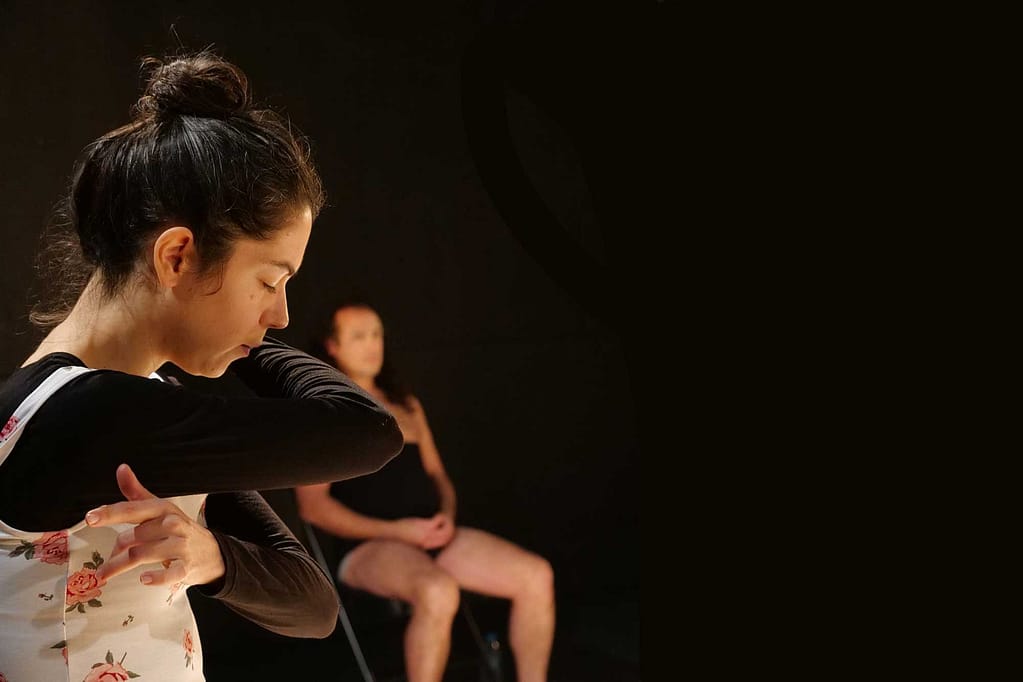
In 1986, a woman dies in a retirement home. This woman is Annie Ernaux’s mother. She was the last link between her daughter and her social origin. A few days later, Annie Ernaux engages in the (crazy) project of writing her mother’s life - a working life (from being a factory worker to being a small shopkeeper), a woman’s life, an ordinary life. A memory work and a writing effort so as to “give birth” to her mother’s story and, in the meantime, restoring her own social path.
Duration 1h
With Karim Abdelaziz, Arthur Dumas, Agathe Fredonnet, Caroline Lerda et Charlotte Le Bras
Stage director Charlotte Le Bras
Assistant Caroline Lerda
Lighting design Nathan Teulade
Soundtrack Les Papavéracées
Additional musics Calico Skies Paul McCartney, Le Choeur des esclaves Giuseppe Verdi, MmmBop Hanson, S’il suffisait d’aimer Céline Dion, Partir Là-Bas La Petite Sirène, You shook me all night long ACDC, Lacrimosa Mozart, Small Town Boy Bronski Beat, Smells Like Teen Spirit Patti Smith (Nirvana Cover)

CHILDHOOD(S) is the last play of our first work cycle. It comes after we “killed the actor” and after we “killed theater”. So, after that, we need to claim another possible way of being on a stage : joyful, committed, bold. But also, delicate. Going upstream the “great actors” of our time and upstream the non-professional actors propelled on stage - we made the collective experiment of becoming our very own “ready made”.
“With this manifesto, I declare that my (self) social exclusion is over.”
[childhood(s)]
We didn’t make it unscathed from our encounters with the writings of Younes Amrani and Annie Ernaux. The “right” way of answering them is to do the same thing as them, with theater, our very own place. We are going to confront our own stories and our own writings, in an attempt to make a “common memory”. Childhood seems to be the right way of entering this piece of work. I have the feeling that stage writing will come before the text writing. I believe that it’s the right way to go when you work on childhood. Because if childhood is the body (the word child comes from the latin infans that means the one who does not speak yet), then, we will have to write with everything that makes the body (sensations, moves, shivers). The authors-actors will have to write with their “art of feeling” : playing. The words will come afterwards. But then, maybe, they will just be the right words of childhood(s).
Charlotte Le Bras – September 2020
Les Papavéracées
Collective stage writing

An empty stage. In the background, at the border between life and theatre, 2 men and 3 women are waiting. They are dressed like children. The music starts and memory surfaces. There, in between revisited versions of the Disney « little mermaid » and Nirvana, we can see the draft of a theatrical selfportrait. The one of a generation born in the middle of the 1980's. It's funny, it's tragic, it's living – it reaches the soul and the body !

[ so, this has to be a manifesto ]
Les Papavéracées